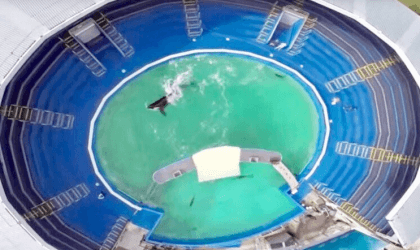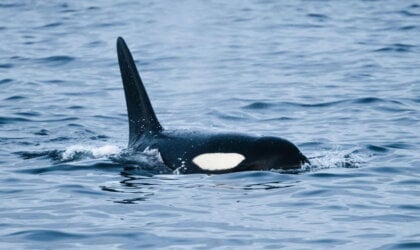
At SeaWorld parks across the U.S., 16 orcas remain imprisoned in concrete tanks. Some of the surviving orcas were violently captured from the ocean. Many others were born in captivity, only to be shuffled between parks and separated from their mothers. Get to know the last orca prisoners at SeaWorld and find out what you can do to help them.
SeaWorld San Diego
1. Corky
Born free around 1965.
In 1969, off the coast of British Columbia, a group of fishermen attacked a pod of orcas. The men forcibly and violently separated calves from their mothers—a bond that many orcas share for life—and sold the animals into captivity. One of the young orcas taken that day was Corky. Corky has been a prisoner for more than 55 years, and at SeaWorld since 1987. Corky has been held captive for longer than any other orca in history.
From 1977 to 1986, at the now-defunct Marineland of the Pacific in California, Corky was used as a breeding machine and bred with her own cousin. None of her babies survived longer than 47 days. In 1987, she was transferred to SeaWorld San Diego, where her last pregnancy ended in a miscarriage. Orcas have strong maternal bonds and many remain with their mothers their entire lives, so the grief Corky must have felt as each of her babies died before reaching adulthood is unfathomable.
2. Ulises
Born free around 1977.
In 1980, when he was only about 3 years old, Ulises was abducted from his family off the coast of Iceland and eventually sent to SeaWorld. Now that Kasatka, Tilikum, and Katina are dead, he and Corky are the last surviving wild-captured orcas being held captive at the abusement parks.
At 20 feet long and nearly 10,000 pounds in weight, Ulises is a giant trapped in a tiny tank. Despite his massive size, animals housed in his tank often bully Ulises. He’s also sustained injuries and endured stress from being trapped with incompatible orca tankmates: Kalia bullied him, and he was “raked” by Kasatka and others in San Diego.
Ulises is aggressive toward and sometimes attacks Corky, having once bitten a chunk out of Corky’s tail flukes, resulting in a near-fatal infection. Aggression is rarely observed between pod-mates in nature, but captive orcas commonly fight with one another. Because captive orcas are not from the same pod, they often speak separate dialects, and the stressful conditions of the tiny concrete tanks can cause them to lash out.
3. Orkid
Born captive in 1988.
Born at SeaWorld, Orkid has never known freedom. Orkid’s mother, Kandu V, was an Icelandic Orca; her father, Orky II, was a Northern Resident. In the ocean, these two types of orcas would not mate with one another, as they have different social structures and speak different dialects, so Orkid is considered a “hybrid” orca.
Orkid spent her early life in a tank with her mother, Kandu V, and Corky. Possibly missing her own dead calves, Corky spent a lot of time close to Orkid in their shared tank at SeaWorld. But this may have led to jealousy. Orkid’s mother, Kandu V, attacked Corky, breaking her own jaw and severing arteries in her head. It took 45 minutes for Kandu V to die in the tank as young Orkid watched.
Orkid has a long history of aggression toward trainers, perhaps a genetic trait passed from both of her parents, a response to the trauma of watching her mother bleed to death, or a result of her imprisonment in an unnatural environment.
4. Keet
Born captive in 1993.
Born at SeaWorld San Antonio, young Keet spent his early life close to his mother, Kalina. When Keet was less than two years old and reportedly still nursing, pregnant Kalina was moved to SeaWorld Orlando. He never saw her again.
The loss of his mother was likely devastating for Keet, as male orcas often stay with their mothers for life in nature. Since then, he has been shuffled between SeaWorld parks five times.
5. Shouka
Born captive in 1993.
Shouka was born at Marineland of Antibes in France. Since Shouka was the first calf born there, the staff was woefully unprepared to care for her. Shouka was underfed and didn’t receive the nutrients needed to grow. When Shouka was eight, she was still the size of a four-year-old orca.
When she was nine years old, Shouka was moved from France to a now-defunct marine park in Ohio. This was the first of many transfers. Like Keet, the abusement parks treated her more like a piece of furniture moved between homes than an individual. After being moved across continents, the Ohio facility kept her in isolation. She spent another year alone after being transferred to Six Flags Discovery Kingdom in 2004. In nature, orcas live in close-knit family groups called pods, so solitary confinement was likely deeply traumatizing and may have caused severe mental deterioration. She was transferred to SeaWorld San Diego in 2012.
6. Ikaika
Born captive in 2002.
Ikaika is the son of Katina and Tilikum, whose own tragic life was revealed to millions in the 2013 documentary Blackfish. When Ikaika was just 4 years old, SeaWorld shipped him from Florida to Marineland in Canada on a breeding loan, ripping him away from his mother. After many years, he was returned to the U.S. and now languishes at SeaWorld San Diego.
7. Kalia
Born captive in 2004.
Kalia is the daughter of Kasatka and Keet. Female orcas typically don’t mate until they’re around 14 years old, but Kalia was still an adolescent when SeaWorld forced her to reproduce. At just 10 years old, Kalia gave birth to Amaya. In 2021, PETA received reports that the park had put all 10 orcas held there together, despite a documented history of aggression among some of them, which led Amaya to chase, rake, and injure Corky. Amaya died in 2021 at just six years old.
8. Makani
Born captive in 2013.
SeaWorld knew that female orca Kasatka had been suffering from a bacterial lung infection for at least three years when they artificially inseminated her again and forced her to bear Makani, her fourth calf, for the parks. Makani was born on Valentine’s Day 2013. When he was four years old, his mother, Kasatka—his primary source of comfort and protection—died from the prolonged illness.
After her death, an eyewitness provided PETA with photos that showed the recently orphaned Makani’s body covered with deep rake marks, injuries caused by the teeth of other orcas.
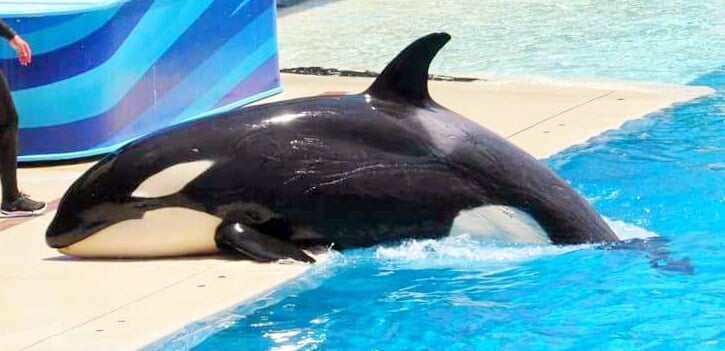 © Chelsy S., Eyewitness
Whenever a young male orca in captivity is separated from his mother, he’s often victimized by the other captive males, often to the point of preferring to be isolated rather than staying with his own species, for fear of being attacked. According to an eyewitness, Makani often beached himself to escape the other orcas in his pool.
SeaWorld San Antonio
1. Takara
Born captive in 1991.
Takara was used as a breeding machine by SeaWorld. She gave birth to five calves, the last orca to give birth at SeaWorld.
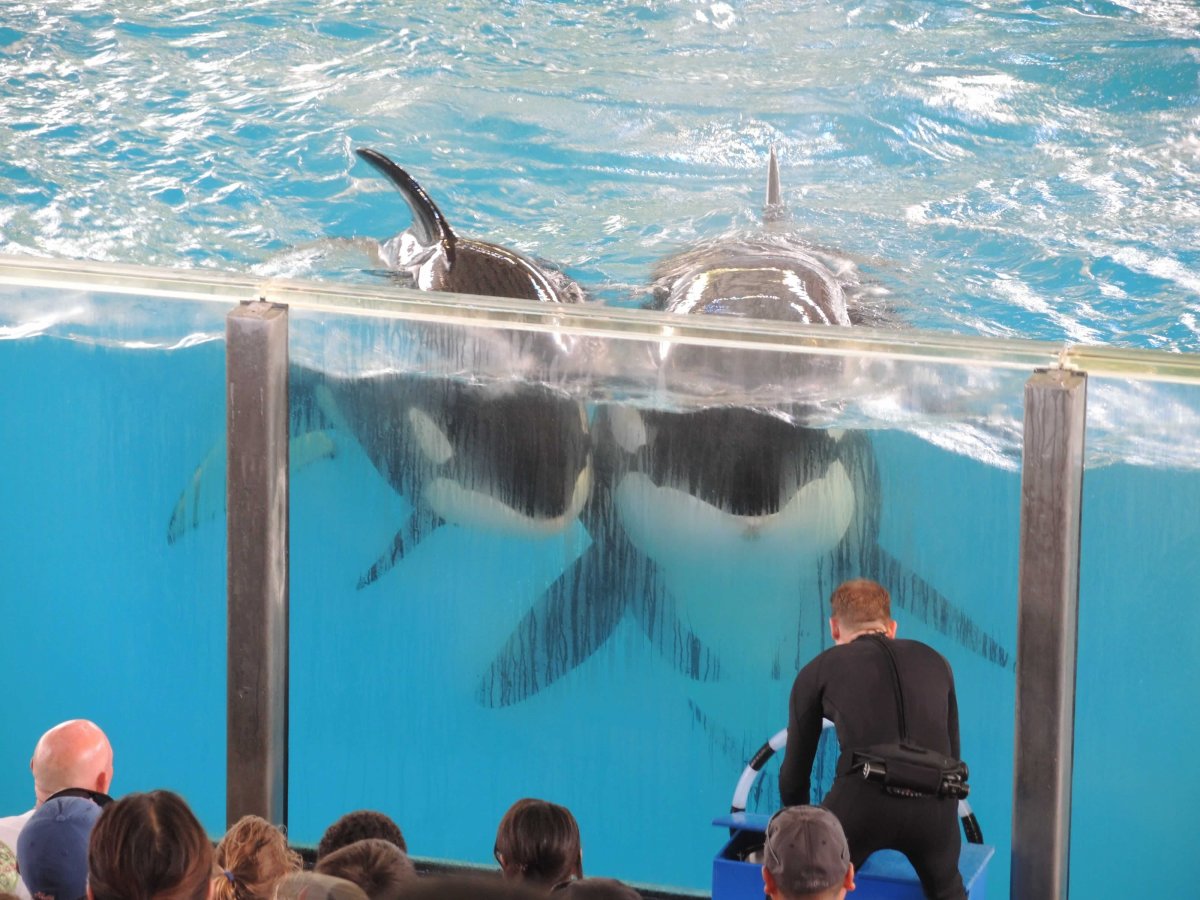
Three of her babies are dead now; Her last calf, Kyara, died at just 3 months old, Kohana died at Loro Parque in 2022, and her daughter, Kamea, died in 2025. Takara’s surviving babies, Sakari and Trua, are still imprisoned at SeaWorld, though only Sakari is at the same abusement park as her mother.
2. Kyuquot
Born captive in 1991.
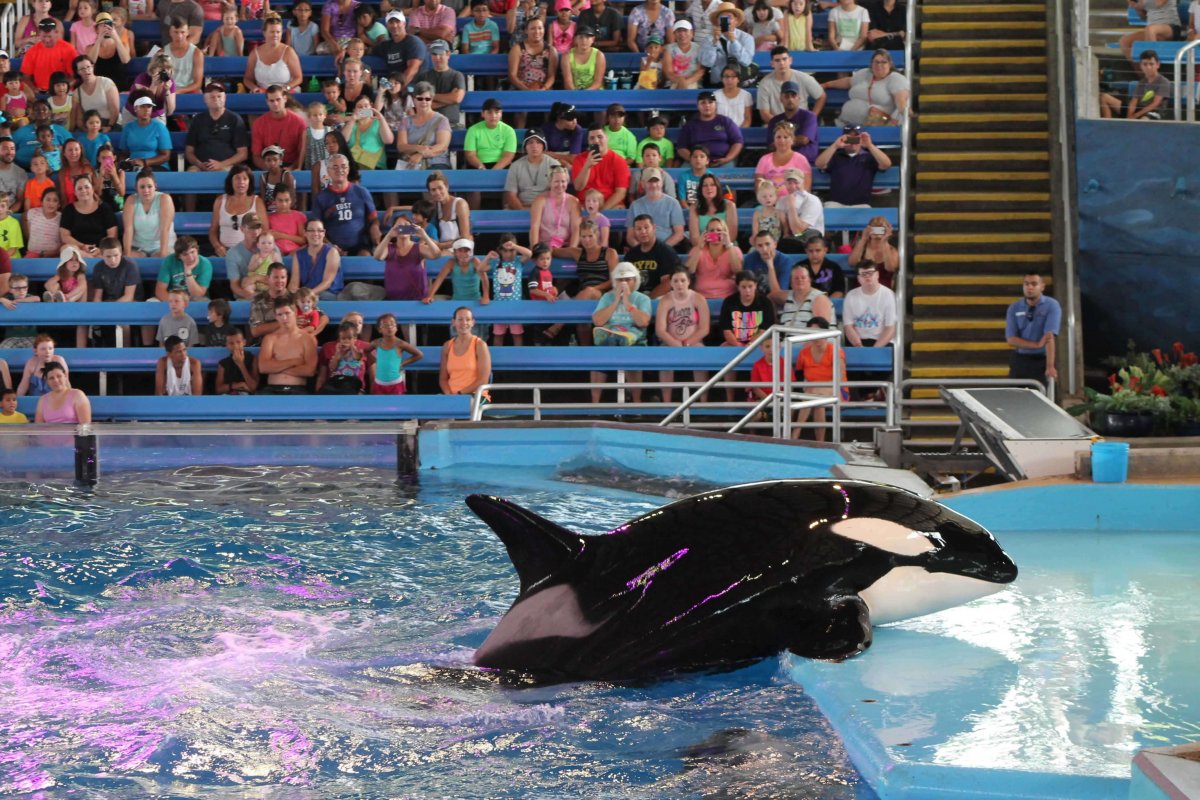
Weighing more than 9,000 pounds, Kyuquot is the largest orca imprisoned at SeaWorld San Antonio. In their ocean habitat, orcas swim up to 150 miles a day—it would take Kyuquot more than 4,280 laps around his tank to swim the same distance.
The cramped SeaWorld tanks Kyuquot and other orcas live in deprive them of everything essential to their physical and mental health. Such deprivation causes them stress, and that stress sometimes causes them to snap. Kyuquot has been involved in numerous incidents involving trainers, the most notable of which was his July 2004 attack on SeaWorld trainer Steve Aibel.
Kyuquot body-slammed Aibel multiple times—dunking the trainer and swimming over him, blocking every attempt at an exit he tried to make.
3. Tuar
Born captive in 1999.
Tuar is the son of Kalina and Tilikum. Like his older half-brother, Keet, Tuar was separated from his mother when he was just a few years old. He was transferred to SeaWorld San Antonio in 2004 and has remained there since.
4. Sakari
Born captive in 2010.
Sakari is the daughter of Takara and Tilikum. Takara was transferred to San Antonio while pregnant with Sakari, so she never had the chance to meet her father. Sakari has spent her whole life at SeaWorld San Antonio.
SeaWorld Orlando
1. Trua
Born captive in 2005.
Trua was born to Takara and Taku, and he is Sakari’s half-sibling. When Trua was only three years old, Takara was transferred to SeaWorld San Antonio. Although Takara is still alive, Trua will likely never see her again.
2. Nalani
Born captive in 2006.
Before separating orca Taku from his mother, Katina, SeaWorld allowed them to breed with each other. Nalani is Taku’s daughter and half-sister.
3. Malia
Born captive in 2007.
Malia was born to Taima and Tilikum. In 2022, Malia was seen with paint chips and other debris stuck in her teeth and mouth, suggesting she’d been chewing on the walls of her tank. While a trainer was removing the debris from her mouth, she bit the trainer’s arm so severely that it required surgery.
4. Makaio
Born captive in 2010.
Makaio is the last of Tilikum’s 21 offspring. SeaWorld imprisons him at the Orlando facility, where he lives with his half-sister Nalani.
How You Can Help the Orcas Imprisoned at SeaWorld
Join PETA in urging SeaWorld to release Corky and the other surviving orcas to seaside sanctuaries, where they can enjoy some semblance of the natural life abusement parks denied them for so long.